
The Book of Revelation
Chapter 1
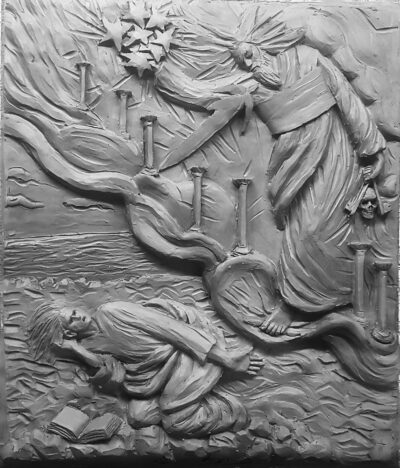
In Chapter 1 of the Book of Revelation, the Apostle John begins by introducing the revelation of Jesus Christ that he received on the island of Patmos. In a vision, John witnesses the glorified Christ, who instructs him to write down what he sees and send it to the seven churches represented as 7 lampstands.
REV1:12-19 When I turned to see whose voice it was that spoke to me, and on turning I saw seven golden lampstands, and in the midst of the lampstands I saw one like the Son of Man, clothed with a long robe and with a golden sash across his chest. His head and his hair were white as white wool, white as snow; his eyes were like a flame of fire; his feet were like burnished bronze, refined as in a furnace, and his voice was like the sound of many waters. In his right hand he held seven stars, and from his mouth came a sharp, two-edged sword, and his face was like the sun shining with full force.
When I saw him, I fell at his feet as though dead. But he placed his right hand on me, saying, “Do not be afraid; I am the First and the Last and the Living One. I was dead, and see, I am alive forever and ever, and I have the keys of Death and of Hades. Now write what you have seen, what is, and what is to take place after this.
Chapter 2
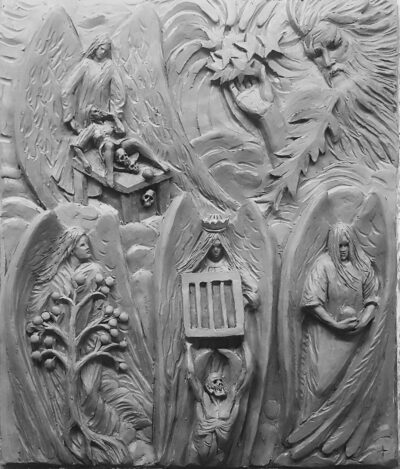
In Chapter 2 of Revelation, the risen Christ instructs the Apostle John to write letters to the first three of the seven churches in Asia—Ephesus, Smyrna, and Pergamum. The imagery involves the symbolic representation of Christ among the churches with the seven golden lampstands and the seven stars held in His right hand. Ephesus is praised for its hard work but admonished for abandoning its first love. The Nicolaitans, a group associated with compromising teachings, are condemned. Smyrna is encouraged to endure persecution, with the promise of receiving the crown of life. Pergamum is warned against the influence of false teachings and is reminded of the authority of the sharp two-edged sword, symbolizing the Word of God. The letters include promises to those who overcome, such as eating from the tree of life, receiving hidden manna, a white stone with a new name, and the Morning Star.
REV2: 7 Let anyone who has an ear listen to what the Spirit is saying to the churches. To everyone who conquers, I will give permission to eat from the tree of life that is in the paradise of God.
Chapter 3
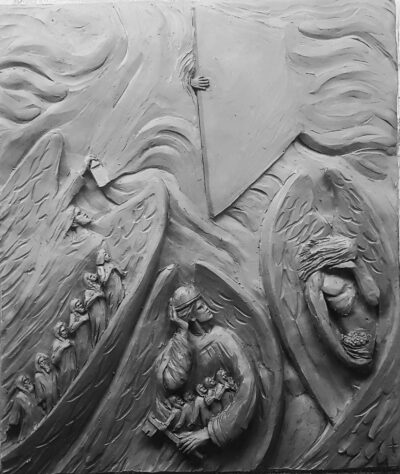
In Chapter 3 of Revelation, the focus shifts to the next four churches—Sardis, Philadelphia, Laodicea, and Thyatira. Christ instructs John to write letters to these congregations. Sardis is rebuked for having a reputation for being alive but being spiritually dead, with a call to wake up and strengthen what remains. Philadelphia is commended for its perseverance and loyalty to Christ, and a promise is made that those who endure will be kept from the hour of trial. Laodicea receives a stern rebuke for its lukewarmness, being neither hot nor cold, and is urged to repent and be zealous. The imagery of gold refined by fire is used to emphasize the importance of spiritual richness. Thyatira is criticized for tolerating a woman named Jezebel, likely symbolic of false teachings, and is warned of coming judgment if they do not repent. The overcomers are promised authority over the nations and the morning star.
REV3: 20-22“Listen! I am standing at the door, knocking; if you hear my voice and open the door, I will come in and eat with you, and you with me. To the one who conquers I will give a place with me on my throne, just as I myself conquered and sat down with my Father on his throne. Let anyone who has an ear listen to what the Spirit is saying to the churches.”
Chapter 4
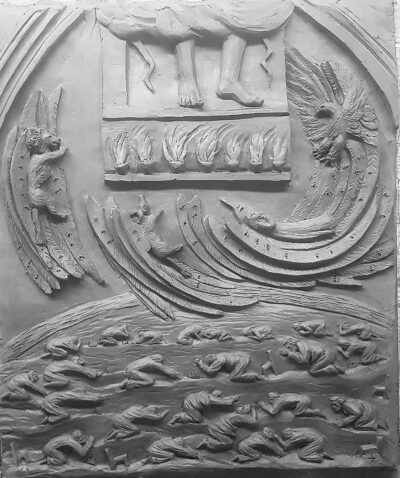
In Chapter 4 of Revelation, John experiences a vision of an open door in heaven, and he hears a voice inviting him to come up and witness things that must take place. Immediately, John is in the Spirit, and he sees a throne in heaven with God seated on it, appearing like jasper and carnelian. Surrounding the throne are twenty-four elders, dressed in white, representing the redeemed, and they worship God continuously. Seven burning torches, symbolizing the seven spirits of God, and a sea of glass are also present before the throne. Four living creatures, each with distinct faces (lion, calf, man, and eagle), full of eyes, worship God day and night, proclaiming His holiness. The constant refrain of “Holy, holy, holy” underscores the divine nature of God. The elders cast their crowns before the throne, acknowledging God’s sovereignty and glory. Thunder and lightning proceed from the throne, emphasizing its power and majesty.
REV4: 10-11 the twenty-four elders fall before the one who is seated on the throne and worship the one who lives forever and ever; they cast their crowns before the throne, singing,
“You are worthy, our Lord and God,
to receive glory and honor and power,
for you created all things,
and by your will they existed and were created.”
Chapter 5
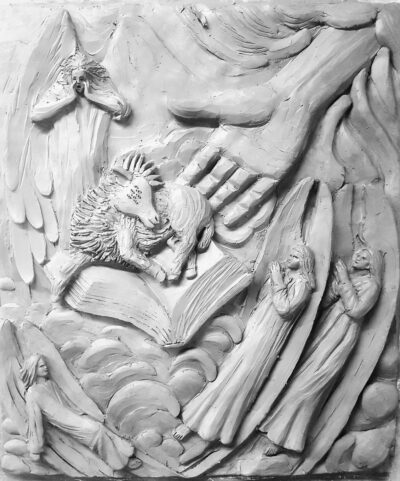
Chapter 5 of Revelation opens with a vision of a scroll sealed with seven seals in the right hand of God, symbolizing a divine plan for the future. A strong angel proclaims with a loud voice, asking who is worthy to open the scroll and break its seals. John weeps when no one is found worthy, but one of the elders reassures him that the Lion of the tribe of Judah, the Root of David, has triumphed to open the scroll. However, when John turns to see the Lion, he sees a Lamb standing as though it had been slain, representing Jesus Christ’s sacrificial death. The Lamb takes the scroll from God, eliciting worship and praise from the elders and living creatures. The song they sing acknowledges the Lamb’s worthiness to open the seals, emphasizing His redemptive work. Myriads of angels join in the worship, declaring the Lamb’s power, wealth, wisdom, strength, honor, glory, and blessing. Every creature in heaven, on earth, under the earth, and in the sea participates in the chorus, affirming the Lamb’s universal sovereignty.
REV5:6-8 Then I saw between the throne and the four living creatures and among the elders a Lamb standing as if it had been slaughtered, with seven horns and seven eyes, which are the seven spirits of God sent out into all the earth. He went and took the scroll from the right hand of the one who was seated on the throne. When he had taken the scroll, the four living creatures and the twenty-four elders fell before the Lamb, each holding a harp and golden bowls full of incense, which are the prayers of the saints.
Chapter 6

In Chapter 6 of Revelation, the Lamb begins to open the seals on the scroll, initiating a series of apocalyptic events. As the first four seals are broken, four horsemen emerge, representing conquest, war, famine, and death, symbolizing widespread tribulations and judgments. The opening of the fifth seal reveals the souls of martyrs under the altar, crying out for justice, portraying the suffering and persecution faced by faithful believers. The sixth seal brings cosmic disturbances, including earthquakes and the darkening of the sun and moon, evoking images of the end times and God’s imminent judgment. Terrified by these events, people attempt to hide from the wrath of the Lamb.
REV 6:7-8 When he broke the fourth seal, I heard the voice of the fourth living creature call out, “Come!” I looked, and there was a pale green horse! Its rider’s name was Death, and Hades followed with him; they were given authority over a fourth of the earth, to kill with sword, famine, and pestilence and by the wild animals of the earth.
Chapter 7
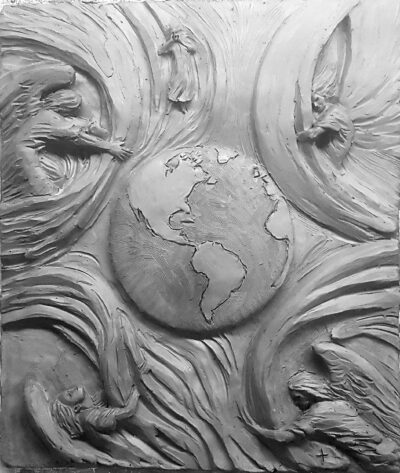
In Chapter 7 of Revelation, there is a pause in the opening of the seals, and John witnesses two significant visions. The first vision involves the sealing of 144,000 servants of God from the twelve tribes of Israel, symbolizing a symbolic and protected group of believers. These individuals are marked for preservation during the impending tribulations. Following this, John sees a great multitude that no one could number, representing people from every nation, tribe, people, and language, standing before the throne and the Lamb. They are clothed in white robes, holding palm branches and worshiping God. An elder explains to John that these are the ones who have come out of the great tribulation, having washed their robes in the blood of the Lamb, signifying their redemption through Christ’s sacrifice. They are now in God’s presence, and He will shelter them from hunger, thirst, and sorrow. The Lamb at the center of the throne will shepherd them and wipe away every tear from their eyes.
REV7 1-3
After this I saw four angels standing at the four corners of the earth, holding back the four winds of the earth so that no wind could blow on earth or sea or against any tree. I saw another angel ascending from the rising of the sun, with the seal of the living God, and he called with a loud voice to the four angels who had been given power to damage earth and sea, saying, “Do not damage the earth or the sea or the trees, until we have marked the servants of our God with a seal on their foreheads.”